

Trip Info
-
5545 m
-
October
-
English
-
B, L, & D
Overview
October is a special time to walk into the Everest region. The summer monsoon has usually moved away from the mountains, the trails become drier, and the high peaks often stand out clearly against the morning sky.
It is also the month when the Khumbu becomes busy again. Teahouses fill up, Lukla flights are in high demand, and you will share the trail with trekkers from all over the world.
That combination is important to understand before you book. October gives you some of the best conditions for mountain views, but it is not a quiet month. If you want clear Himalayan scenery and don’t mind meeting plenty of other trekkers, it is an excellent time to make the journey to Everest Base Camp.
The trek itself takes you from the small mountain airstrip at Lukla through the Sherpa settlements of Phakding and Namche Bazaar, then higher into Tengboche, Dingboche, Lobuche and Gorak Shep before reaching Everest Base Camp.
The altitude changes dramatically along the way, so the best October itinerary is not the one that gets you there fastest it is the one that gives your body enough time to adapt.
Is October a Good Time for the Everest Base Camp Trek?
Yes. October is one of the most popular times to trek to Everest Base Camp. The main reason is the combination of relatively dry conditions, good visibility and comfortable daytime trekking temperatures at lower and middle elevations.
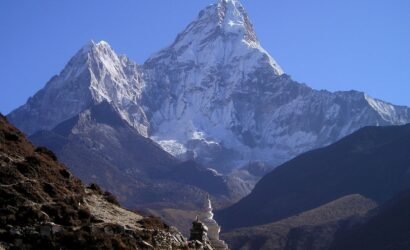
After the monsoon, the mountains often look noticeably cleaner. On a clear morning around Namche, Tengboche or Dingboche, you can see the surrounding peaks without the persistent cloud cover associated with the summer months. As you climb higher, the scenery becomes increasingly dramatic, with Ama Dablam, Lhotse, Nuptse, Everest and other Himalayan giants dominating the landscape.
But there is a trade-off.
October is peak trekking season, so you should expect company on the trail. Namche Bazaar can be lively, popular teahouses can fill quickly, and Gorak Shep has limited accommodation compared with the number of trekkers who want to stay there.
For someone trekking to Everest Base Camp for the first time, this isn’t necessarily a disadvantage. The busy season means you meet other trekkers, the villages have a lively atmosphere, and the trekking infrastructure is operating at its busiest.
If your priority is clear mountain scenery and dependable trekking conditions, October is a strong choice. If your priority is solitude, you may want to consider a quieter month.
Everest Base Camp Trek in October Weather
October weather in the Everest region is generally much more settled than during the monsoon months, but Himalayan weather should never be treated as completely predictable.
The biggest difference you notice while trekking is the change in temperature with altitude.
Around Lukla and Phakding, afternoons can still feel relatively comfortable. Namche is cooler, especially in the shade, while Dingboche and the settlements beyond it feel distinctly alpine. By the time you reach Lobuche and Gorak Shep, the cold becomes part of the daily trekking experience.
A typical October day often starts cold, warms up when the sun reaches the trail, and becomes cold again once the sun drops behind the mountains.
This is why layering works better than carrying one extremely heavy jacket. You may start the morning wearing several layers, remove one while climbing in the sunshine, and put it back on during a lunch stop or when the wind picks up.
What can you expect from October weather?
- Generally drier trails than during the monsoon
- Frequent clear mornings
- Strong mountain visibility on favorable days
- Cold mornings and evenings
- Increasingly cold conditions above 4,000 m
- Occasional cloud, wind or precipitation
- Possible snow at higher elevations
- Strong sunlight during the day
The first and second halves of October can also feel different. Weather varies from year to year, so it is better to think of October as a generally favorable season rather than a guaranteed weather window.
Everest Base Camp Temperature in October
The temperature changes substantially as you gain elevation. You should not pack for the temperature in Kathmandu and assume the same clothing will work at Everest Base Camp.
| Trekking Area | Approx. Daytime Conditions | Approx. Nighttime Conditions |
|---|---|---|
| Lukla | 15°C to 20°C | 5°C to 10°C |
| Namche Bazaar | 10°C to 15°C | Around 0°C to 5°C |
| Tengboche | 5°C to 12°C | Around -5°C to 0°C |
| Dingboche | 5°C to 10°C | Around -5°C to -10°C |
| Lobuche | 0°C to 7°C | Around -8°C to -12°C |
| Gorak Shep | Around -2°C to 5°C | Around -10°C or lower |
| Everest Base Camp | Around -5°C to 5°C | Often below -10°C |
These are approximate ranges, not a daily forecast. Wind, cloud cover, altitude and the particular weather pattern that year can make conditions feel significantly colder.
The practical lesson is simple: October may feel pleasant in the lower Khumbu during the afternoon, but you need serious cold-weather clothing for the upper part of the trek.
Everest Base Camp Trek in October: Crowds and Views
If you have seen photographs of the Everest Base Camp trail looking completely empty, October probably isn’t when you’ll experience it that way.
The route becomes busy because October is one of Nepal’s major trekking months. You will meet independent trekkers, organized groups, guides, porters and local residents moving between the villages.
The busiest places are usually the major overnight stops and accommodation hubs, particularly Namche Bazaar and Gorak Shep.
One way to make the experience more comfortable is to start your walking days early. You get cooler conditions, better morning light for photography and a head start on the trail.
What about the mountain views?
This is where October earns its reputation.
Clear mornings can reveal an impressive collection of Himalayan peaks, including:
- Mount Everest
- Lhotse
- Nuptse
- Ama Dablam
- Thamserku
- Kongde
- Pumori
- Cholatse
- Taboche
The landscape also changes as you climb.
Below Namche, forests and rivers dominate the trail. Around Tengboche, you still have a mixture of forest and open mountain views. After Dingboche, trees become scarce and the landscape becomes wider, drier and more exposed.
By Lobuche and Gorak Shep, you are walking through a high-altitude landscape where rock, moraine, glaciers and enormous mountain walls replace the greenery of the lower Khumbu.
That gradual transformation is one of the best parts of the EBC trek.
Why Trek to Everest Base Camp in October with Everest Region Trek?
Choosing the right month is only one part of a successful EBC journey. The itinerary, acclimatization schedule, guide support and preparation matter just as much.
At Everest Region Trek, the focus should be on getting you through the Khumbu safely and comfortably rather than simply getting you to Base Camp as quickly as possible. October gives you the opportunity to experience the region when the mountains are at their most visible and the trekking community is at its liveliest.
You come for Everest, but the journey is much bigger than the Base Camp sign: the first suspension bridge after Lukla, the bustle of Namche, the quiet mornings around Tengboche, the thin air of Dingboche, the memorials above Lobuche, the glacier around Gorak Shep, and finally the moment you reach the foot of the world’s highest mountain.